Free Delivery
 365-Day Returns
 10 Million Happy Customers
 500,000 Products in Stock
Bathroom Storage Ideas: Vanity Units, Cabinets & Small-Space Solutions
Reviewed by the Beliani Content Team · Updated September 2026
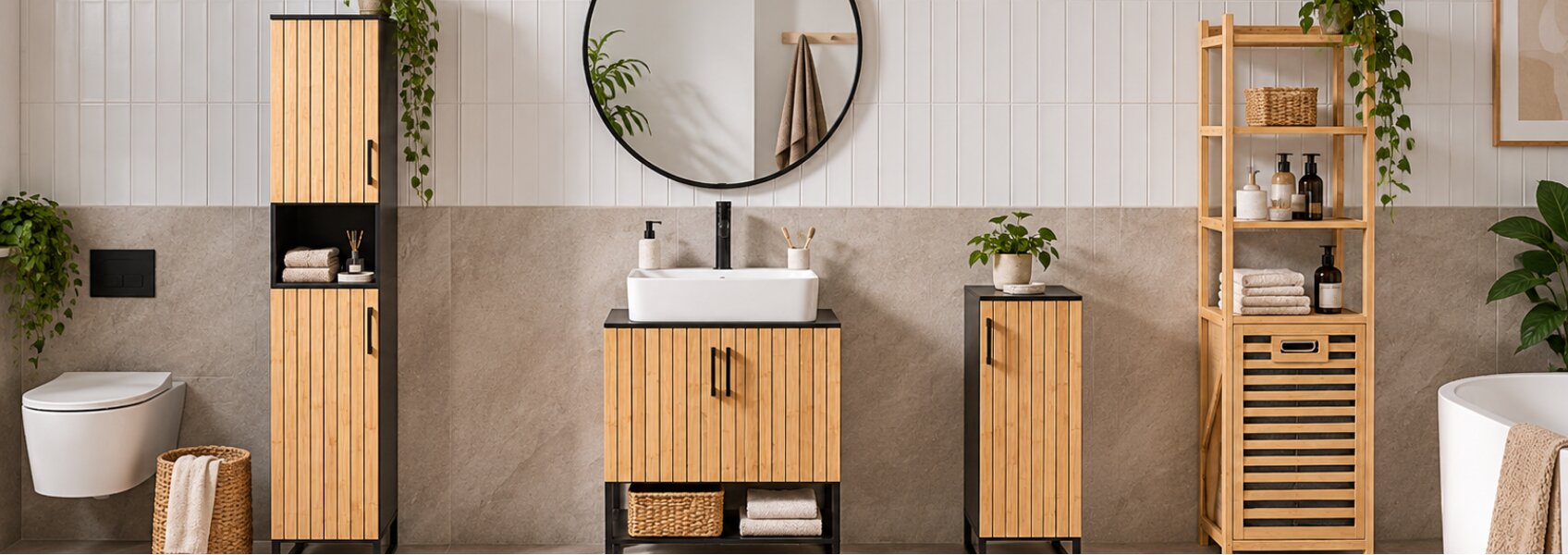
Bathrooms hold a disproportionate amount of clutter for their size: toiletries, towels, cleaning supplies and spares all need a home, usually in a room too small to spare much floor space. Getting storage right means matching each item to the right kind of unit rather than adding furniture until the room feels full. This guide works through vanity units, cabinets, shelving and the small-space tactics that make the most of a compact bathroom.
What is the best storage solution for a small bathroom?
A wall-hung vanity unit paired with a mirrored cabinet above it is the most space-efficient combination, since both stay off the floor and use vertical wall space that would otherwise go unused. For very narrow rooms, a slimline unit around 40-50cm wide with a 15-20cm depth fits where a full-size vanity cannot.
- Floor space: wall-hung units suit rooms under 4m² where every centimetre of floor counts
- Daily routine: households needing quick access to towels benefit from open shelving alongside closed cabinets
- Moisture exposure: units near the shower need sealed, water-resistant finishes more than units by the door
What size vanity unit fits a small bathroom?
For a small bathroom, the most comfortable vanity width is 50-60cm, since this is wide enough to use the basin without splashing water on the floor but narrow enough to leave the room feeling open. Where floor space is very tight, a 40-50cm unit still works for quick hand-washing, though it will feel cramped for a full washing routine. Depth matters as much as width: a standard vanity is 45-53cm deep, but slim and wall-hung models bring this down to 20-40cm, which is usually the better choice in a small room.
| Vanity width | Best for | Trade-off |
|---|---|---|
| 40-50cm | Cloakrooms, very tight bathrooms, quick hand-washing | Splashing is more likely; not ideal for a full wash routine |
| 50-60cm | Most small-to-standard bathrooms, daily use | The comfort sweet spot for a single user |
| 80-100cm+ | Larger bathrooms, sometimes two taps side by side | Needs generous wall width to avoid overcrowding the room |
Mounting height also affects daily comfort. The standard height from floor to the top of the basin is 81-91cm, and it is worth adjusting within that range to suit whoever uses the bathroom most: closer to 81cm suits shorter users and children, while 86-91cm is more comfortable for taller adults.
Clearance around the basin matters as much as the unit itself. Leave at least 50-70cm of free floor space in front of the vanity so you can bend and move comfortably, and around 20cm on either side, from the basin's centre to the nearest wall or fixture, so elbows don't knock against it while washing.
Wall-hung vanity units leave the floor beneath them visible, which makes a small bathroom read as larger and simplifies cleaning underneath. Floor-standing units offer more internal storage volume for the same width, since the plinth area is usable space rather than a gap, which suits households that need to store more than toiletries, such as spare linen.
A common mistake: choosing depth before width
In a small bathroom, unit depth affects daily comfort more than width. A cabinet that protrudes 35-40cm into a narrow room can make the space feel cramped even if its width fits the wall perfectly, so measure the walking clearance in front of a unit before confirming its depth, not just the wall space it will occupy.
Does the basin type change how much storage I get?
A countertop basin sits on top of the unit and takes up worktop space, but it leaves the full cabinet volume underneath free for storage. A semi-recessed or fully inset basin uses some of that internal space for the basin's plumbing and underside, trading storage capacity for a lower overall unit height. For a narrow room, an inset basin with a slim cabinet body is usually the better fit.
Shop now: vanity units
Open or closed: how should I split bathroom storage?
What should go in a closed bathroom cabinet?
Cabinets suit anything better kept out of sight and away from steam. A freestanding tall cabinet, typically 30-40cm wide and up to full room height, adds significant enclosed storage without needing extra floor footprint beyond its own base.
- Spare toiletries and cosmetics
- Cleaning products
- Medicines
- Electrical items, such as a hairdryer
Mirrored cabinets do double duty by combining a mirror with concealed shelving, particularly useful over a basin where a separate mirror would otherwise take up wall space. A mirrored cabinet deeper than about 15cm above a basin can start to feel intrusive in a small room, so a shallow model is usually the better choice.
Fix tall cabinets to the wall
Bathroom cabinets should be fixed to the wall rather than left standing on their feet alone. This matters most for tall units, which are more likely to tip if bumped or climbed on.
Shop now: bathroom cabinets and mirrored cabinets
What belongs on open shelving instead of behind a door?
Open shelving works best for items used daily and items that benefit from airflow, such as towels, since trapped moisture behind a closed door can encourage mildew on damp textiles. Floating shelves above the basin or beside the bath make use of otherwise empty wall space without adding the visual bulk of a full cabinet.
Limit open shelving to what is genuinely used often. A shelf stacked with rarely-used bottles reads as clutter rather than storage, while the same shelf holding two or three rolled towels and a single plant reads as considered. Grouping items by type, rather than spreading them across several shelves, keeps the display calmer to look at.
Shop now: bathroom shelving
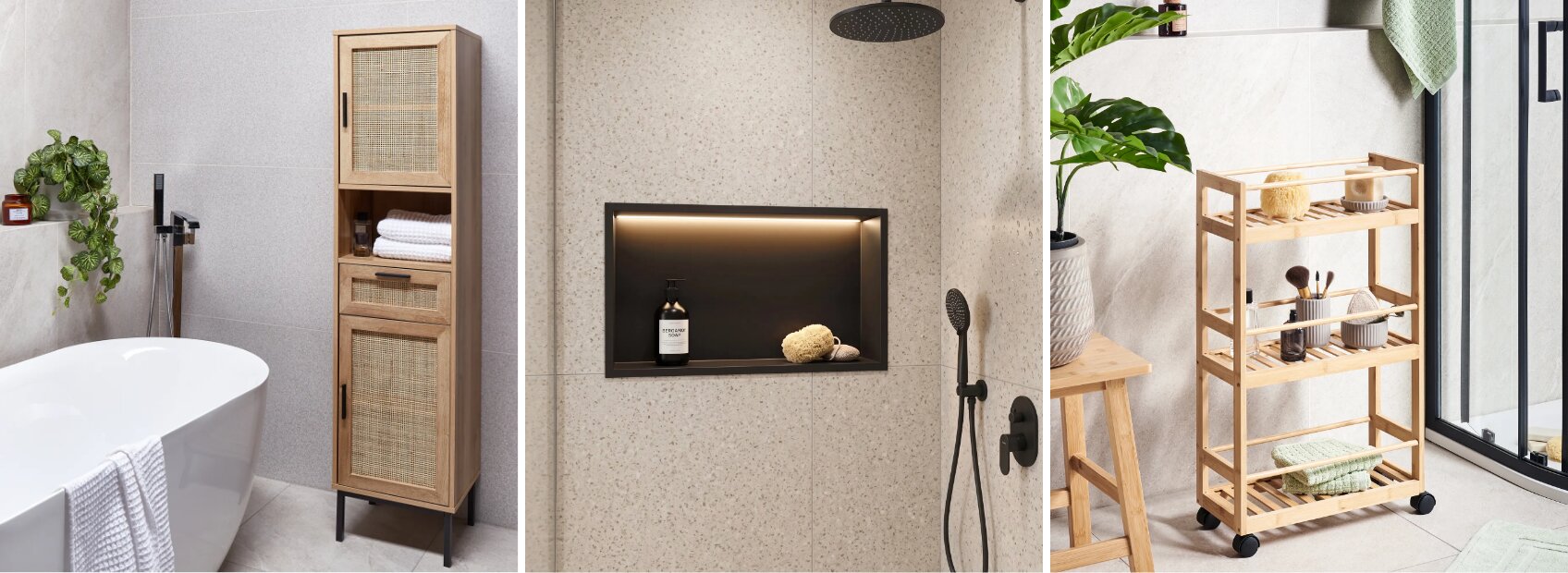
Which materials hold up best to bathroom humidity?
Bathroom furniture needs to withstand humidity, occasional splashes and temperature changes in a way that furniture for other rooms does not. The carcass material and its finish make the biggest difference to how well a unit copes over time.
Standard choice
MDF with a sealed lacquer or melamine finish
The sealed surface stops moisture reaching the core board, which makes this the standard material for bathroom units. It performs reliably across the whole room, including areas that see regular splashes.
Conditional choice
Solid wood with a water-resistant treatment
Solid wood can be used if it carries a specific water-resistant treatment, but it is best kept away from direct splash zones such as the area immediately around a basin or shower screen.
Low-maintenance choice
Metal
Powder-coated or stainless steel doesn't absorb moisture at all, which makes it a reliable option for shelving and accessory units, though it can feel colder in tone than a wood-effect finish.
Natural choice
Bamboo
Bamboo copes naturally with humidity better than most solid woods, since its density and growth structure make it less prone to swelling. It works well for shelving and smaller storage pieces kept away from direct splash zones.
Don't overlook the hardware finish
Hardware matters as much as the carcass material. Stainless steel or coated metal handles and hinges resist the corrosion that plain steel develops in a humid room, so it is worth checking the hardware finish specifically rather than assuming it matches the durability of the main unit.
Which mechanisms and features are worth choosing?
Beyond size and material, a few practical features make a real difference to how a bathroom unit performs day to day.
- Soft-close doors and drawers — stops slamming, reducing wear on the hinges and noise in a small, echo-prone room
- Built-in lighting — most often in mirrored cabinets, adds usable task light around the basin without a separate wall fitting
- Easy-clean surfaces — smooth, sealed finishes resist limescale and dust build-up better than textured ones
- Concealed handles — a push-to-open door or recessed handle gives a cleaner look and removes a protruding edge, a small safety plus in a tight space
How do the main storage types compare?
| Storage type | Best for | Space impact |
|---|---|---|
| Wall-hung vanity unit | Rooms under 4m², daily basin storage | Frees floor space, visible floor reads larger |
| Floor-standing vanity unit | Larger storage needs, family bathrooms | More capacity, but reduces visible floor |
| Mirrored cabinet | Concealed items above the basin | Combines mirror and storage in one wall zone |
| Open shelving | Daily-use towels and toiletries | Adds visual bulk if overfilled; needs airflow |
| Tall freestanding cabinet | Spare supplies, cleaning products | Takes floor footprint but adds most enclosed volume |
How can I make the most of a genuinely small bathroom?
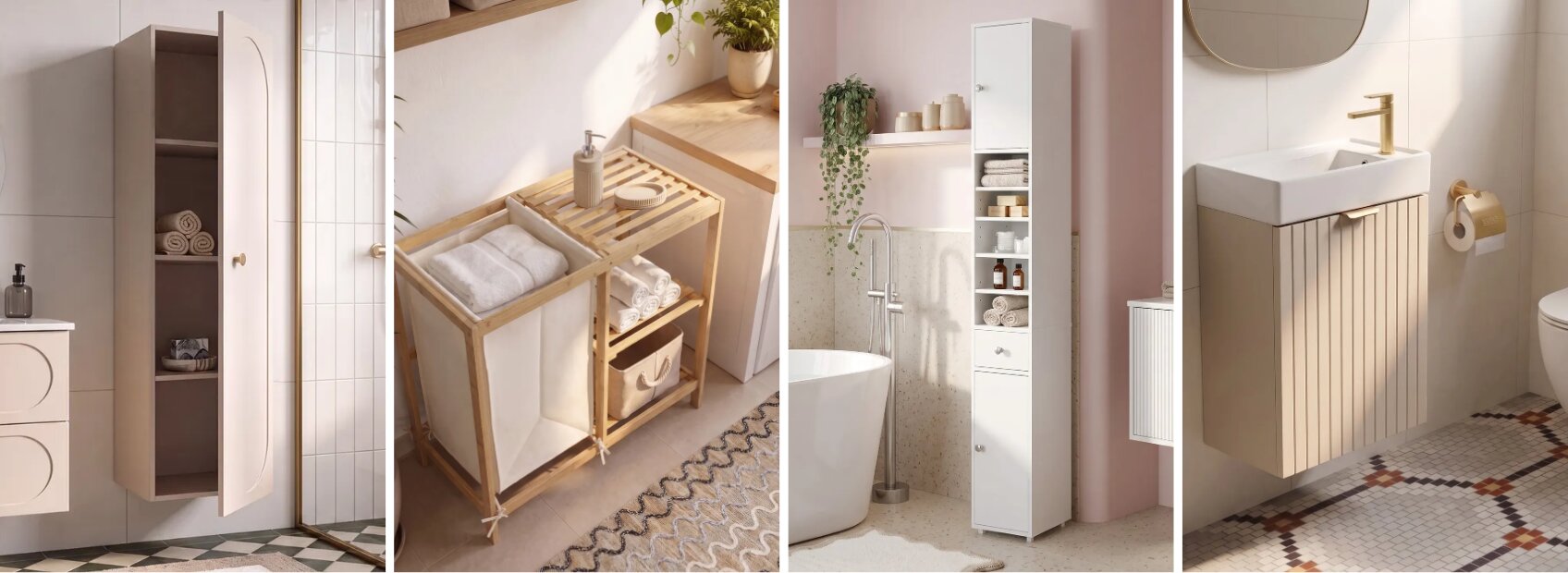
In a compact bathroom, the corner above the basin or beside the door is often the only unclaimed wall space, and a narrow corner cabinet can use it without interfering with movement through the room. Stacking storage vertically, such as a tall slim cabinet rather than a wide low one, keeps the floor footprint minimal while still holding a useful volume.
Consistency in container type also helps a small room feel organised rather than cramped. Matching baskets on open shelving, or a single storage colour that matches the cabinet finish, reads as considerably tidier than a mix of container styles and colours, even when the actual volume of stored items is the same.
Would you like to discover more tips for making the most of small spaces? Take a look here!
What should you check before buying bathroom storage?
Before choosing a unit, work through the following checks in order.
- Wall width and depth clearance, measured at the narrowest point of the intended spot
- Basin type (countertop, semi-recessed or inset) and how much internal cabinet volume it leaves free
- Finish rated for humidity, particularly for anything within splash range of the shower or bath
- Hardware material, since plain steel hinges and handles corrode faster in humid air
- Door swing and drawer clearance against the room's walking space
- Whether the unit can be fixed to the wall, which matters most for tall cabinets but applies to bathroom furniture generally
- How much of the stored contents need daily access versus occasional access, to split between open and closed storage
Summary
Getting bathroom storage right
There's no single best bathroom storage solution - the right combination depends on room size, moisture exposure and how often each item is used. If you're short on floor space, start with a wall-hung vanity and mirrored cabinet, then decide on cabinets versus open shelving based on how often you reach for what's inside. Save the tall freestanding cabinet for overflow items you don't need daily, and match the material and hardware finish to how close the piece sits to water. Whatever combination you choose, fix tall units to the wall rather than leaving them freestanding, since this is the one point that affects safety rather than just convenience.
Frequently asked questions
What dimensions should my vanity unit have?
For most small bathrooms, aim for a vanity 50-60cm wide and 20-40cm deep, mounted with the basin's top edge 81-91cm from the floor. Leave 50-70cm of clear floor space in front and around 20cm on either side for comfortable use.
How do I match a basin to my vanity cabinet?
The basin should sit fully within the cabinet's width and depth, with a small margin on each side rather than overhanging the edges. If you're fitting a wall-mounted tap, check its spout reach against the basin's depth, since a mismatch here means water lands too close to the edge or too far back in the bowl.
Does bathroom furniture need to be fixed to the wall?
Tall units and cabinets should be screwed to the wall rather than left freestanding on their legs alone, mainly for safety reasons rather than looks. This matters most for tall cabinets, since a top-heavy unit is more likely to tip if knocked or climbed on, but it is good practice for other bathroom furniture too.
Is it better to have open shelving or closed cabinets in a bathroom?
Closed cabinets suit anything you want protected from steam and splashes, such as electricals or spare toiletries. Open shelving works best for items used daily, like towels or soap, since airflow around them reduces the risk of mildew.
What material holds up best to bathroom humidity?
MDF with a sealed, water-resistant lacquer or melamine finish is the standard choice for bathroom furniture, since it resists swelling better than untreated solid wood. Metal and bamboo are also good options, since both cope with humidity without needing the same sealed finish as wood-based boards.