It looks like you're visiting from another country. Switch to your local Beliani site?

Stay on this site
Go to local site
  Free Delivery
  365-Day Returns
  10 Million Happy Customers
  500,000 Products in Stock
Free Delivery
365-Day Returns
4,52 ( 298.405 Ratings)

Ratings

4,52 (298.405)

5 stars(221.384) 4 stars(45.556) 3 stars(10.200) 2 stars(7.220) 1 star(14.045)
Show more
Contact & Help

Do you have any questions?

Chat with us

Monday - Friday, 08:00 - 18:00

Response time: 2 min.

Write us

Response time: 24-48h

Write us

Call us

+385 1 884 8116

Monday - Friday, 08:00 - 18:00

My messages My account Track my order Frequently asked questions

English

    Choose your language

  • English
Menu
Categories
  • New
  • Christmas
  • Garden & Balcony
  • Home Accessories
  • Living Room
  • Bedroom
  • Dining Room
  • Bathroom
  • Home Office
  • Hallway
  • Textiles
  • Kitchen
  • Kids Room
  • Lighting
  • Rugs
My account
  • Homepage
  • Contact us
  • Language
  • My account
  • Privacy Policy
  • Newsletter
  • FAQ

Contact

Chat with us

Monday - Friday, 08:00 - 18:00

Response time: 2 min.

Write us

Response time: 24-48h

Write us

Call us

+385 1 884 8116

Monday - Friday, 08:00 - 18:00

My messages My account Track my order Frequently asked questions

Language

Last searches Clear

Wishlist
Basket

How to Choose Bedroom Furniture That Fits Your Space

Reviewed by the Beliani Content Team · Updated September 2026

Bedroom furniture

Choosing bedroom furniture starts with understanding your space. The right bed size, storage solutions and furniture arrangement can make a bedroom easier to use and more comfortable every day. This guide explains how to plan your layout, choose the right pieces and avoid common fitting mistakes.

In short

How do you plan bedroom furniture?

Plan for 60–70 cm of walking space beside the bed frame on each accessible side. Measure the room, mark doors, windows and radiators, then position the bed before adding storage. As starting allowances, leave 80–100 cm in front of a chest of drawers and 90–120 cm in front of a dressing table. Check the chosen furniture’s full opening dimensions and allow extra room where needed.

How do you measure a bedroom before choosing furniture?

Draw a simple plan and record every measurement in centimetres. Measure the room itself first, then add the furniture footprints and the space needed to use them. Mark your proposed layout on the floor with low-tack tape before ordering so you can test the route from the door to the bed, windows and storage.

Measure the usable walls

Measure each wall from corner to corner, including alcoves and recesses. Note skirting boards and other projections that prevent furniture sitting flush. For a tall wardrobe, record the ceiling height and check the product’s assembly instructions for the extra space needed to build or raise it.

Mark doors, windows and radiators

Measure from a fixed corner to each door, window and radiator, then record its width and projection. Sketch the full door swing and note window-sill height, sockets, switches and curtain space. Keep radiator controls accessible and follow the radiator manufacturer’s clearance guidance.

Check the full furniture footprint

Use the product’s overall width, depth and height, rather than mattress size or internal storage dimensions. Include headboards, handles and projecting feet. Tape the outline onto the floor and check the largest delivery package against doorways, stair turns and lift dimensions.

Allow space to open and use furniture

Add the full extension of drawers, the swing of hinged doors and the space needed to pull out a chair. Check which end or side an ottoman bed opens from. Try the layout with these parts open: you should still be able to reach the bed, exit the room and use nearby furniture.

Bed: the starting point of the room

Choose the mattress size you need, then compare the bed’s full external dimensions with your floor plan: an upholstered frame or deep headboard can take up more room than the mattress alone. Check whether the mattress and base are included, which mattress sizes the frame accepts and whether the combined bed-and-mattress height feels comfortable to sit on. For storage beds, confirm the opening direction and make sure bedside tables, rugs or a sloping ceiling will not obstruct drawers or a lifting base.

Shop now: beds

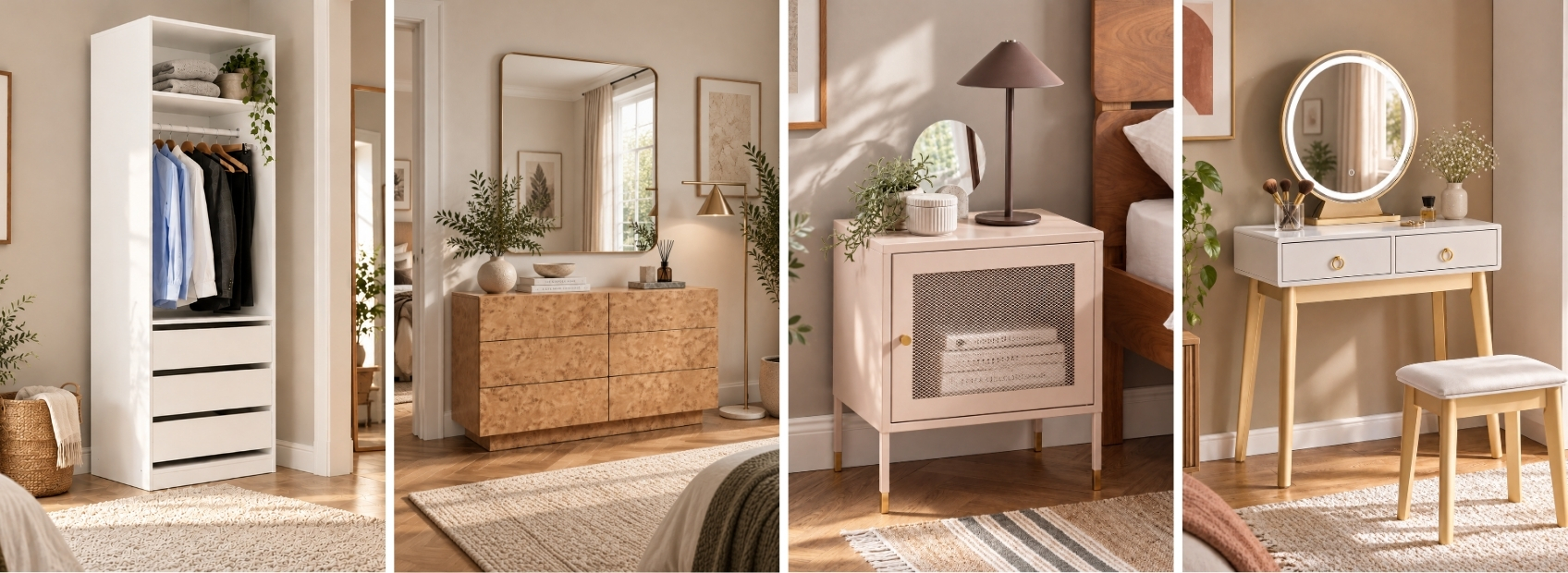
Wardrobe: for hanging clothes and larger items

Take stock of what you will store before choosing the interior: long coats and dresses need a different hanging arrangement from shirts, folded knitwear and shoes. Compare the usable internal dimensions, rail positions and shelf spacing, not just the cabinet’s outside size. Hinged doors need a clear swing area; sliding doors avoid that swing but still need standing space in front. Check that internal drawers can open with the doors in their required position and follow the supplied wall-fixing and assembly instructions.

Shop now: wardrobes

Chest of drawers: for folded clothes and smaller belongings

Check the usable width, depth and height inside each drawer against the items you plan to store. Shallow drawers suit small accessories, while deeper drawers can accommodate bulkier folded clothing. Measure the chest with a drawer fully extended and leave room to stand in front of it. Check drawer load limits in the product details, keep the room door clear of the handles and follow the manufacturer’s wall-anchoring instructions.

Shop now: chests of drawers

Bedside tables: for everyday essentials

Measure from the floor to the top of your mattress and use that as a starting point when comparing bedside-table heights. Check that you can reach the surface comfortably while lying down. Allow enough tabletop space for a lamp and your everyday essentials, and keep sockets and charging cables accessible. Before choosing drawers or doors, check their opening direction against the bed frame and any under-bed storage. A compact shelf can be worth considering where floor space is limited.

Shop now: bedside tables

Dressing table: when you need a dedicated preparation area

Compare the chair’s seat height and width with the dressing table’s knee space; armrests also need to fit if you want to tuck the chair away. Check where table drawers open and whether a seated person can use them. Position the mirror where daylight or a task light illuminates your face, and keep a socket within reach without trailing cables across a walkway. Measure with the chair pulled out, not only when it is stored under the table.

Shop now: dressing tables

bedroom storage furniture collage

Which bed size and type work best for your bedroom?

The right bed depends on both the available space and how you use the bedroom. A larger bed provides more sleeping comfort, but it also reduces the space available for wardrobes, bedside tables and movement around the room. Consider the bed size together with the type of storage or functionality you need.

Bedroom situation Recommended bed size Bed types to consider Why choose it
Small bedroom Single or small double bed Storage bed with drawers, ottoman storage bed, sofa bed Saves space and adds storage or flexibility.
Narrow bedroom Small double or double bed Regular double bed, storage bed with drawers Keeps the layout practical and easy to move around.
Large bedroom King-size or super king-size bed Regular double bed, divan bed, ottoman storage bed Allows more sleeping space while leaving room for additional furniture.
Guest bedroom Single or small double bed Sofa bed, divan bed, regular double bed Keeps the room flexible for guests and other uses.
Limited storage Double, king-size or super king-size bed Ottoman storage bed, storage bed with drawers, divan bed Adds storage without requiring extra cabinets.

How should you arrange bedroom furniture?

Start with the bed, then position storage and the dressing table around the space needed to open and use them. These four views show which areas to check before committing to a layout.

60–70 cm

Bed and bedsides

Leave room beside the bed

Allow 60–70 cm of walking space beside the bed frame on each accessible side for getting in and making the bed. Keep bedside tables near the headboard and leave access on both sides of a shared bed where possible. Storage drawers need extra room to open fully.

80–100 cm

Chest of drawers

Keep drawers and doorways clear

Allow 80–100 cm in front of the chest as a starting point, then check the drawer’s full extension and space to stand. Keep drawers clear of the room-door swing and the main walking route.

Wardrobe

Check the full door swing

The shaded area shows where to leave room for opening the doors and standing. Check the chosen wardrobe’s opening dimensions and make sure internal drawers can slide out fully. Sliding doors still need access space in front.

90–120 cm

Dressing table

Allow space to pull out the chair

Allow 90–120 cm in front of the table as a starting point for pulling out and using the chair. Check that the chair fits beneath the table, and add more room if someone needs to walk behind it.

Layout sorted? Now find out how to give your bedroom a hotel-style look.

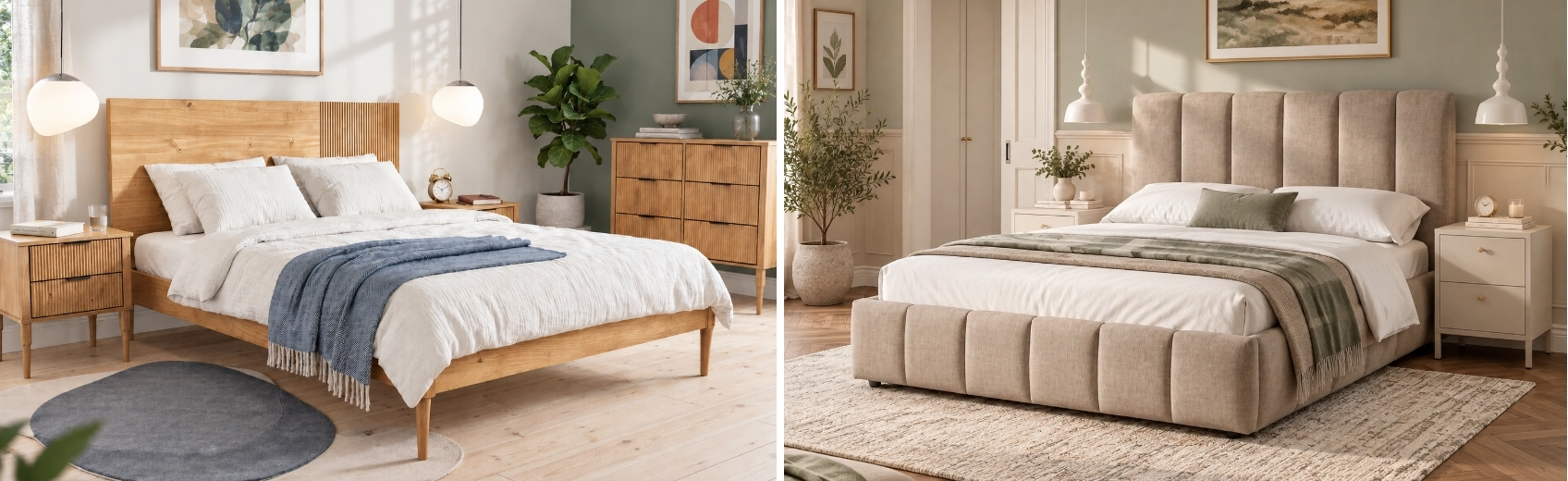
bedroom styles collage

What to check before buying bedroom furniture

Before ordering, check these key points:

  • Furniture size: Make sure the bed, wardrobe and other pieces fit the room.
  • Opening space: Check that doors, drawers and storage mechanisms can be used comfortably.
  • Storage needs: Choose furniture that matches what you actually need to store.
  • Room layout: Confirm that furniture placement works with doors, windows and walking routes.
  • Delivery access: Measure doorways, hallways and stairs before ordering larger pieces.

Frequently asked questions

What bedroom furniture should you buy first?

Start with the bed because it determines the available space for the rest of the room. Once the bed position is confirmed, choose storage furniture such as wardrobes and chests of drawers based on the remaining space and your storage needs.

How much space should you leave around a bed?

Allow 60–70 cm of walking space beside the bed frame on each accessible side so you can move comfortably and make the bed easily. Measure from the outer frame, not the mattress. Allow extra room for opening storage drawers or nearby wardrobe doors.

Can you put a bed under a window?

Yes, a bed can go under a window if the window can still open, curtains can move freely and the radiator is not blocked. A lower headboard usually works better in this position than a tall upholstered or canopy design.

How do you choose the right wardrobe size?

Choose a wardrobe size based on the amount of clothing you need to store and the space available in the bedroom. A larger wardrobe is useful if you need more hanging space, while a combination of rails, shelves and drawers can be more practical than choosing only by external size.

How do you combine bedroom furniture from different collections?

Bedroom furniture from different collections can work well together when you repeat one or two design elements, such as the same wood tone, colour palette, handle style or leg shape. Choose one main piece, such as the bed, and match other furniture with details that complement it rather than trying to make every item identical.

news

Enter your email address to subscribe to our exclusive newsletter with many discounts

Forgotten password?

Please enter the email address linked to your Beliani account, and we’ll send you a reset link.
Email

A new password has been sent

If an account with this email exists, you’ll receive an email with instructions to reset your password.

Log in

Share

Share this via email
Or copy link here
  • beliani.at
  • beliani.be
  • beliani.ch
  • beliani.cz
  • beliani.de
  • beliani.dk
  • beliani.es
  • beliani.fi
  • beliani.fr
  • beliani.hu
  • beliani.it
  • beliani.nl
  • beliani.no
  • beliani.pl
  • beliani.pt
  • beliani.ro
  • beliani.se
  • beliani.si
  • beliani.sk
  • beliani.co.uk
    "shop/shop_static_content.tpl"
    Cookies
    We use cookies and other technologies to offer you safe and reliable functioning of the page, as well as the best possible experience on our website.
    You can find more information in our cookies policy.
    Cookies

    We Use Cookies

    We use cookies to improve your experience on our website. Use the buttons below to allow all, or individual cookies.

    Necessary Cookies

    These cookies are needed for our website to function and cannot be deactivated. They are used, for example, to ensure that you, as a registered user, always remain logged in when accessing various sub-pages of our online shop and that you do not have to re-enter your login data every time you access a new page.

    Functionality Cookies

    With these cookies, our online shop is able to provide extended functionalities. They can be set by us or by third-party providers whose services we use on our website. If you do not allow these cookies, some or all of these services may not work properly.

    Marketing Cookies

    Targeting and performance cookies can be set by our advertising partners via our website. They are used to collect information about the web pages visited by the user in order to present advertisements tailored to you. They do not directly store personally identifiable information, but are based on a unique identification of your browser and internet device. If you do not allow these cookies, you will experience less targeted advertising.