Free Delivery
 365-Day Returns
 10 Million Happy Customers
 500,000 Products in Stock
How to Choose the Right Outdoor Dining Set
Reviewed by the Beliani Content Team · Updated September 2026
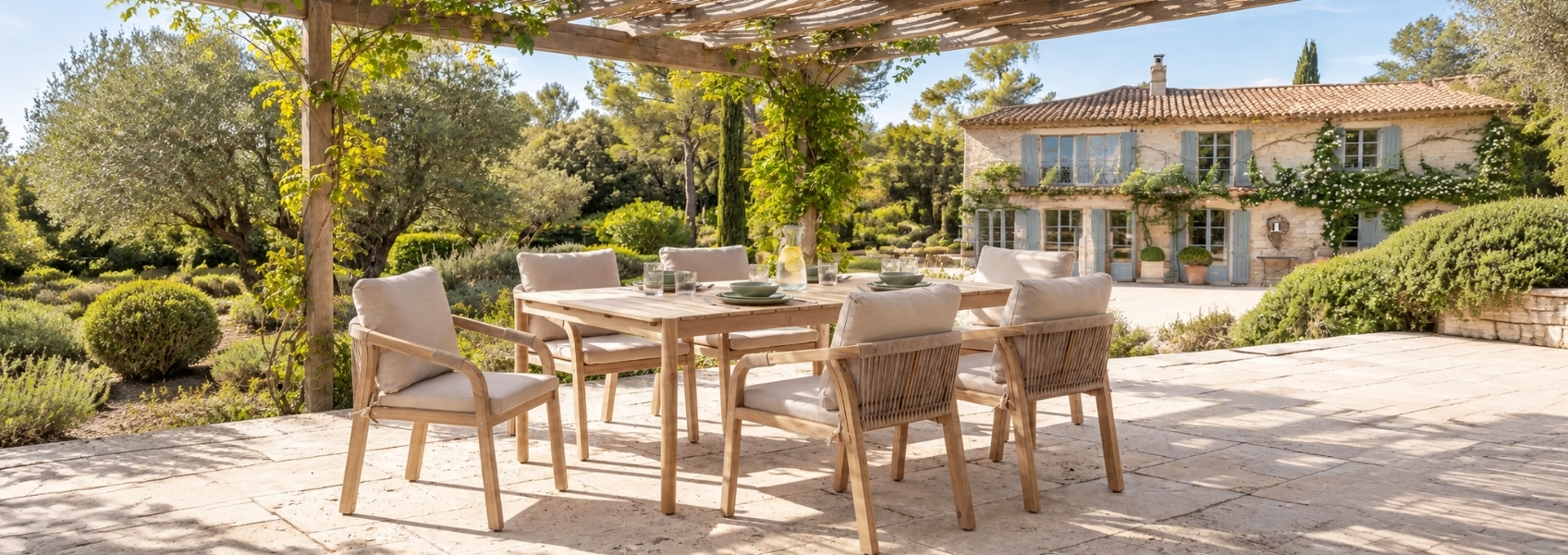
An outdoor dining set has to do more than an indoor one: it carries a full table of food, stands in the rain for months at a time and often has to disappear into a shed for winter. The size you choose decides how many people you can realistically seat, and the materials decide how much work the set makes for you every spring. This guide covers both, along with the comfort and weather details that only become obvious once the set is already on the terrace.
In short
What size outdoor dining set do I need?
Allow 60 cm of table edge per person, and keep 90 cm of clear space around the table so chairs can be pushed back without hitting a wall or a planter. Six people therefore need a rectangular table of about 180 × 90 cm, or a round table of about 150 cm, on a terrace of roughly 3.6 × 2.7 m. Measure the free space first and let it decide the table size, rather than choosing the table and hoping the chairs fit.
- How often you eat outdoors: occasional use suits a folding or extending table
- How exposed the spot is: a sheltered terrace allows lighter frames than a roof terrace or coastal garden
- Whether you need a parasol hole through the middle of the table
- How much dry storage you have for cushions and chairs over winter
How much space does an outdoor dining set need?
Measure the usable space, not the whole terrace. The area that counts is the flat, level surface where the table and all its chairs can stand, excluding the strip you walk through to reach the door and any space taken by planters or a barbecue.
Leave 90 cm between the table edge and the nearest obstruction. About 75 cm is the minimum for pulling a chair out and sitting down, and 90 to 100 cm lets someone walk behind a seated guest without asking them to shuffle forward.
Keep the table at least 80 cm deep, and 90 cm if you serve dishes in the middle. Below 70 cm, two people sitting opposite end up with their knees and their plates competing for the same space.
Round, rectangular or extending
Rectangular tables seat the most people per square metre and can sit against a wall when not in use, which suits narrow terraces and balconies. Round tables suit square spaces and shorter table lengths, because everyone can see everyone, and there are no corners to catch a hip on a tight walkway. Extending tables are the compromise worth paying for if you eat outdoors as a couple most days and as a group a few times a season.
| Number of people | Rectangular table | Round table | Space needed, including chair clearance |
|---|---|---|---|
| Four | 120–140 × 80 cm | 110–120 cm across | About 3.2 × 2.6 m |
| Six | 180 × 90 cm | 140–150 cm across | About 3.6 × 2.7 m |
| Eight | 220 × 100 cm | 160–180 cm across | About 4.0 × 2.8 m |
Shop now: garden dining sets and garden chairs
Which frame material lasts outdoors with the least work?
The frame decides the weight of the set, how it copes with rain and salt air, and how much seasonal maintenance you take on. Match it to your climate and to how exposed the spot is, not to the look alone.
Aluminium
Rust-proof and easy to handle
Powder-coated aluminium cannot rust, so it copes with rain and salt air with no annual treatment. It is also the lightest of the common frame materials, which makes chairs simple to stack, carry and rearrange, though on a windy roof terrace they are better stacked away after a meal than left standing.
Teak
Heavy, stable and low-maintenance
Teak contains natural oils that let it stay outside untreated, weathering from honey brown to silver-grey without losing strength. The weight keeps it steady in wind and the price is higher, so it rewards a permanent dining spot rather than a set you move around.
Acacia
Solid wood at a friendlier price
Acacia is dense and hard-wearing, and it gives the warm look of solid wood for considerably less than teak. It holds far less natural oil, so it needs oiling once or twice a season to stay water-repellent and to slow the fine surface cracking that untreated acacia develops in full sun.
Poly rattan
Woven look without the upkeep
Synthetic rattan woven over an aluminium frame resists UV and moisture far better than natural wicker, which should stay under cover. Check that the frame underneath is aluminium rather than coated steel if the set lives outside all season.
Steel
Solid, but the coating is everything
Powder-coated steel gives useful weight at a lower price than teak. It only rusts where the coating is broken, so touch up chips promptly and check the feet, which sit in standing water and usually corrode first.
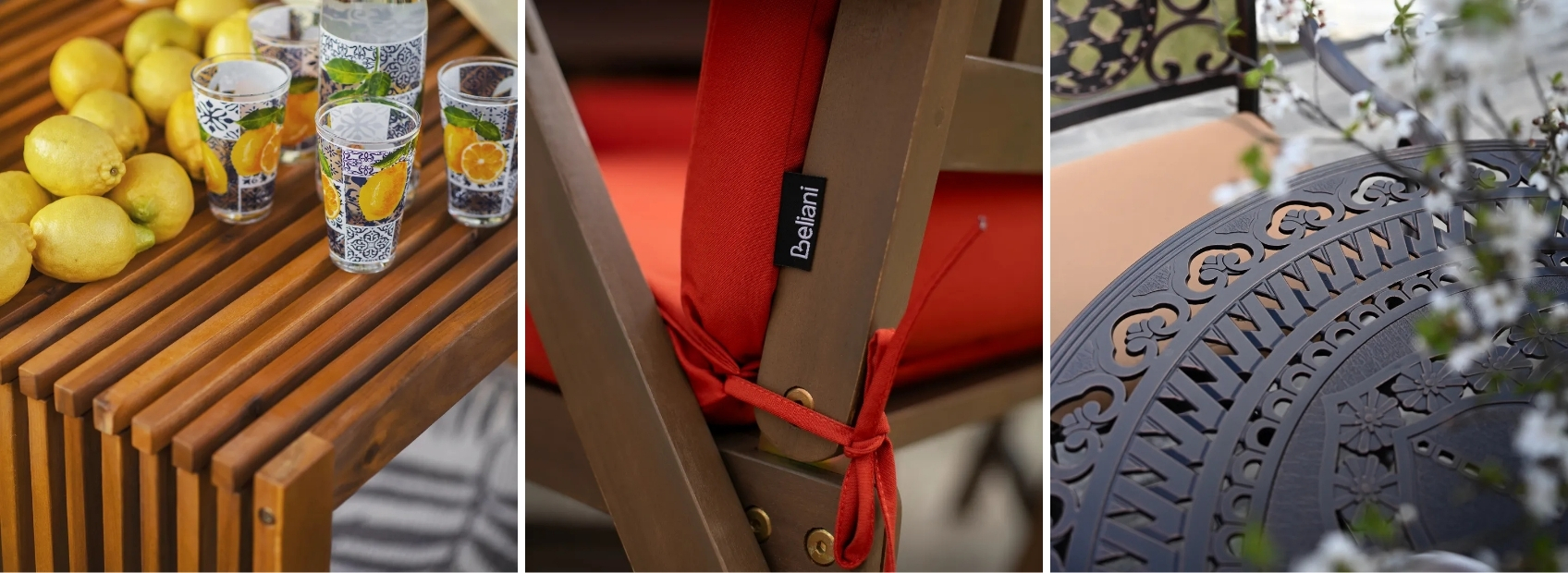
Tabletops behave differently from frames
A set can have a rust-proof frame and a tabletop that fails first, so judge the two separately. Ceramic and HPL tops resist heat, stains and scratching and are the easiest to wipe down after a meal. Tempered glass keeps a small terrace looking open but shows every water spot and can be broken by a falling branch or hail. Wooden slat tops need the gaps between the slats kept clear so rain drains instead of sitting in the joints.
Read more: outdoor furniture material guide
What measurements determine chair comfort, and how do they affect it?
Outdoor dining tables follow the same heights as indoor ones: 74 to 76 cm to the top, with seats at about 45 cm, leaving 27 to 30 cm between the seat and the underside of the tabletop. Anything much tighter and your legs press against the table frame for the whole meal.
Armchairs are where mismatched sets go wrong. Measure from the ground to the underside of the table edge, usually 60 to 65 cm, and compare it with the height of the armrests. If the arms are taller, the chairs will not tuck in and the set needs more floor space than you planned for.
Choose the seat surface for your climate. Sling and mesh seats in textilene drain and dry within minutes of a shower, which suits changeable weather and sets that stay out. Cushioned seats are more comfortable for long meals but need somewhere dry to live, so check that the covers are removable and that the foam is a quick-dry type before committing to them.
Count the chairs you will store, not just the chairs you will use
Once the season ends, every chair in the set needs a place to go, and a six-seat set is six chairs to find room for. Stacking chairs pile into roughly the footprint of one chair, folding chairs go flat against a wall, and fixed-frame armchairs and benches take up real floor area in a shed or garage.
How to fit a parasol into the set?
If you want shade over the table itself, the table needs a parasol hole, and the pole has to fit it. Pole diameters vary between models, so compare the hole size in the table specification with the pole size in the parasol specification rather than assuming any two will match.
A parasol used through a table still needs a base underneath. The table steadies the pole but does not anchor it, and without a base the whole load is carried by the rim of the hole, which is a particular risk on a glass top.
Where the table has no hole, a cantilever parasol shades the table from the side instead. It needs its own weighted base clear of the seating area, so add that footprint to the space you measured earlier.
Read more: choosing a garden parasol
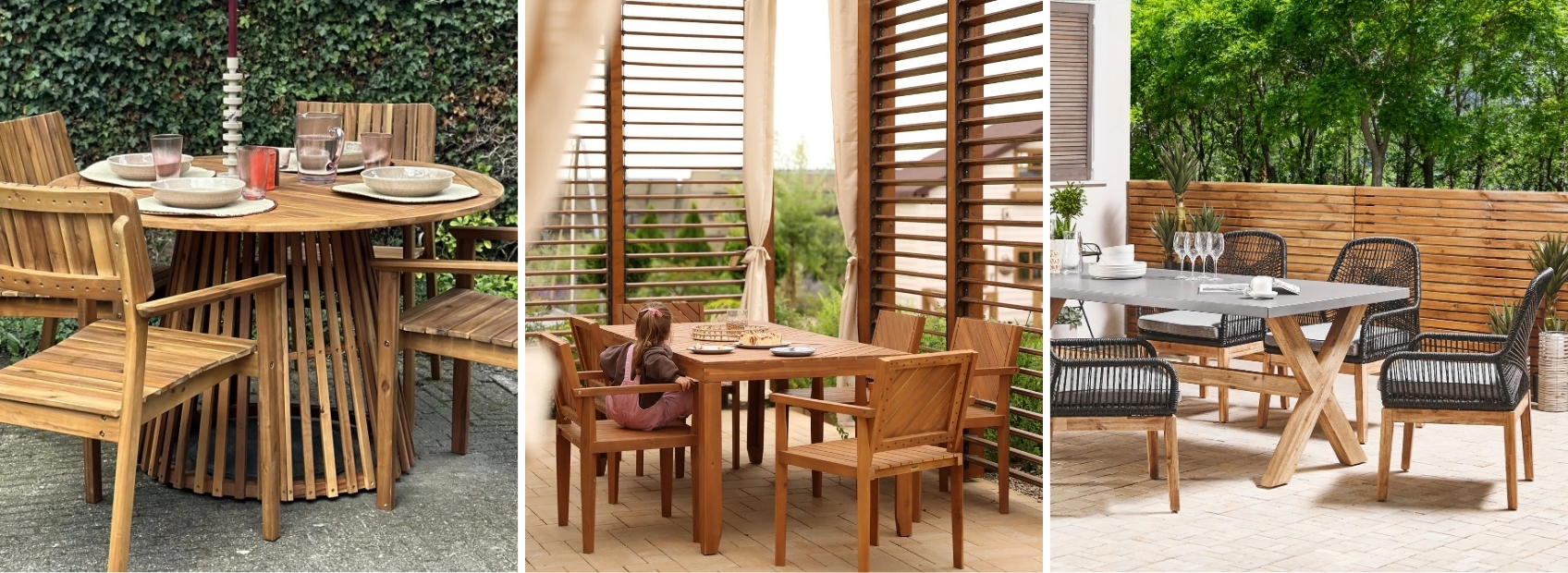
How should you store an outdoor dining set in winter?
The best way to protect an outdoor dining set is to store it indoors or in a covered, dry place during the colder months. This helps prevent moisture damage, protects cushions and reduces the effect of changing temperatures.
If indoor storage is not possible, use a suitable furniture cover and place the set on a dry surface away from standing water. Remove cushions and soft accessories before covering the furniture, as trapped moisture can lead to mould and material damage.
Before storing the set, clean and dry all surfaces carefully. Wooden furniture may need seasonal maintenance according to the manufacturer's instructions before it is put away.
What to check before buying
Work through these with a tape measure, standing in the spot where the set will actually go.
- The usable space measured, then the table size chosen to leave 90 cm clear on every open side
- 60 cm of table edge per person, counting the number of people you usually seat rather than occasional guests
- Clearance under the table edge, usually 60 to 65 cm, against the armrest height if the chairs have arms
- Frame and tabletop materials matched to how exposed and how wet the spot is
- The parasol hole in the table against the pole of the parasol you intend to use
- Whether the chairs stack or fold, and where they will go once the season ends
- A vented cover available in the right size, plus dry indoor space for the cushions
Frequently asked questions
Should I choose an extendable outdoor dining table?
An extendable table is useful if you need flexibility for both everyday meals and larger gatherings. It allows you to save space when fewer people are dining while adding extra seating when needed.
How do I stop a garden table wobbling on an uneven terrace?
Start with the adjustable feet fitted to most metal tables and level the table before blaming the paving. If the feet run out of travel, a thin rigid shim under one leg holds better than folded card, which compresses and slips over time.
Are benches a sensible alternative to garden chairs?
Benches seat more people in less space because you can allow about 50 cm per adult instead of 60 cm, and they push fully under the table when not in use. The trade-off is no back support and no armrests, so they suit shorter meals better than long evenings at the table.
How do I maintain an outdoor dining set?
Maintenance depends on the material, but regular cleaning and correct storage help extend the lifespan of outdoor furniture. Remove dirt with suitable cleaning products, dry the furniture after washing and follow the manufacturer's care instructions for materials such as wood or metal.