Free Delivery
 365-Day Returns
 10 Million Happy Customers
 500,000 Products in Stock
How to Use Mirrors to Make Your Space Look Bigger
Reviewed by the Beliani Content Team · Updated September 2026
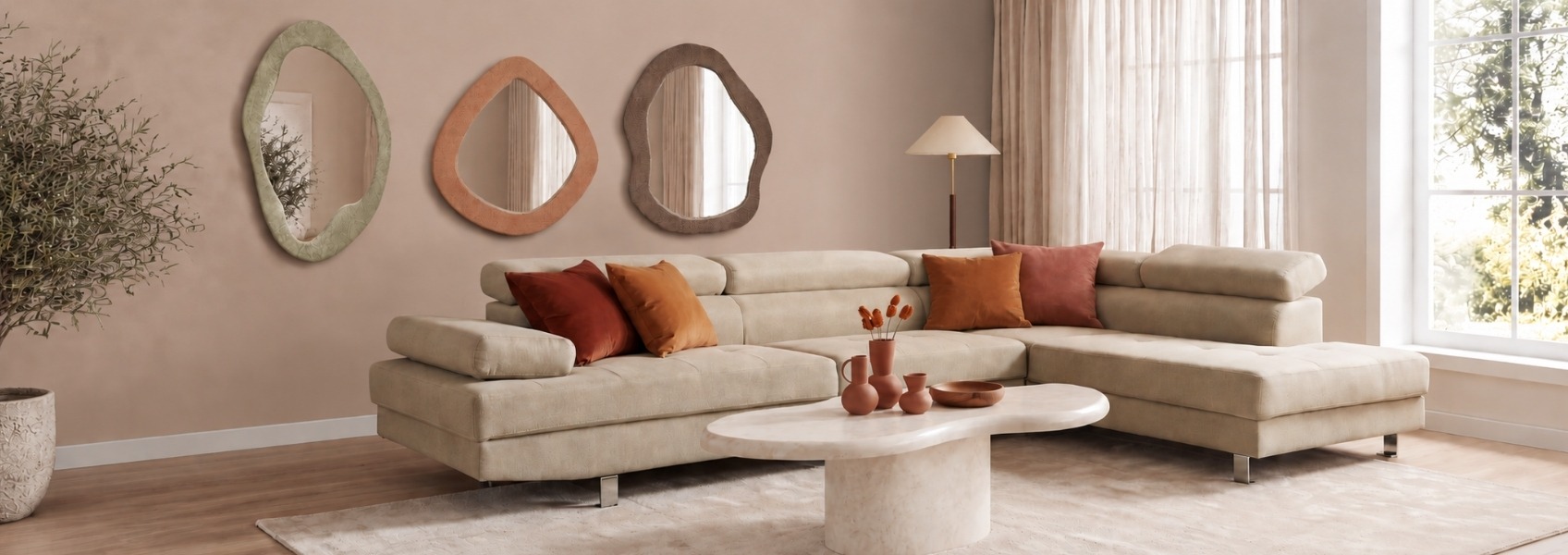
Mirrors are one of the few decorating tools that can genuinely reshape how large a room feels, without moving a single wall or altering the floor plan. In a boxy bedroom, a narrow hallway or a small living room, the same square metre of glass can double the sense of light and depth within minutes of hanging it. Getting there depends on where the mirror sits and what it reflects, not on buying more mirrors.
In short
Where should you hang a mirror to make a room look bigger?
Hang a large mirror on the wall facing or perpendicular to your main window so it reflects natural light and the view outside rather than a blank wall. The mirror should cover at least two-thirds of the wall or furniture width beneath it, and one large piece does more for a small space than several small ones. Position the centre of the mirror at eye level (roughly 145–165cm from the floor) and mount it flat against the wall rather than tilted for the truest reflection and maximum light bounce.
How high and at what angle should a mirror sit?
For most rooms, hang the centre of the mirror at eye level, roughly 145–165cm from the floor. For a full-length piece leant or fixed against the wall, let the bottom edge sit around 15–25cm off the floor rather than flush with it, so the frame stays clear of skirting boards and cleaning equipment.
A flat, wall-mounted mirror gives the truest reflection and the most consistent light bounce. A deliberately tilted or leaning mirror introduces some distortion, which suits a relaxed, styled corner in a bedroom but works against the effect if maximum brightness and depth is the goal.
Read more: lighting ideas to enhance the mood of a room
Best mirror placement by room
The general placement rule holds everywhere, but each room has its own constraint worth working around.
Living room
Angle it toward the brightest point
If the room doesn't directly face outside, angle the mirror to catch a floor lamp or the brightest corner instead of the window, and keep the frame slim so it doesn't compete with other art on the same wall.
Shop now: living room furniture
Bedroom
Lean it opposite the bed, not facing it
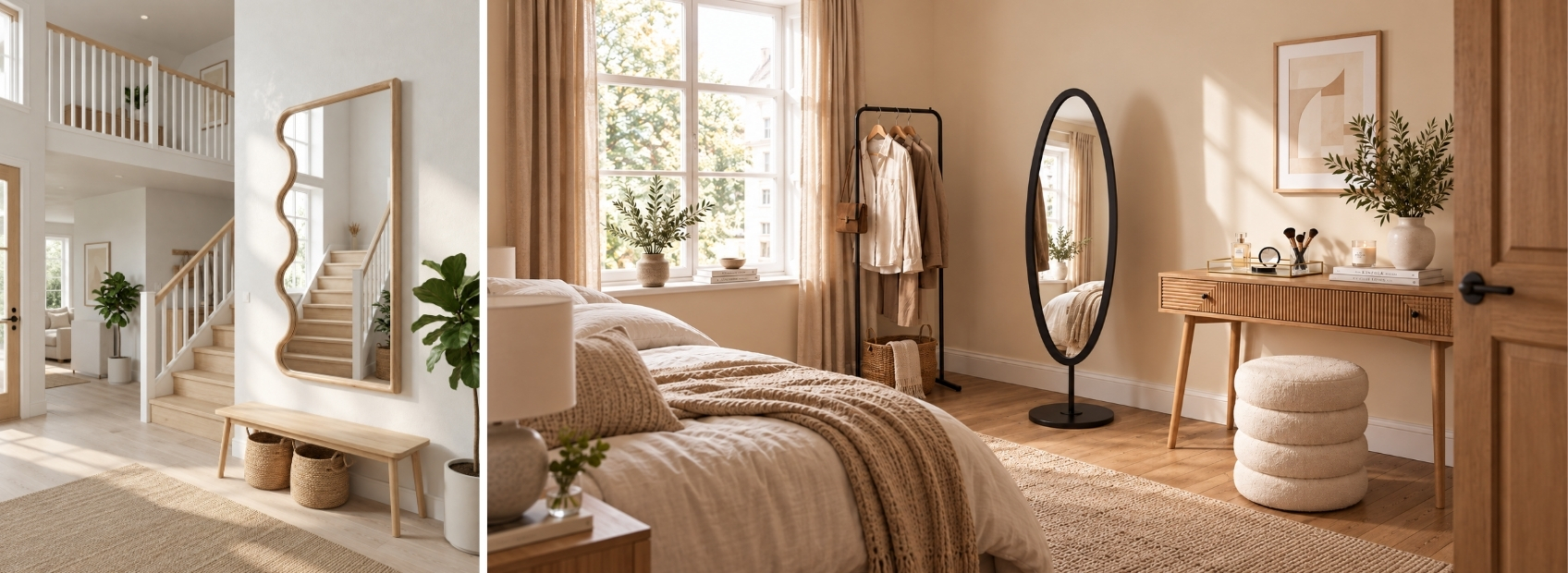
A full-length leaning mirror against the wall opposite the bed doubles the sense of ceiling height and doubles as an outfit check. Avoid facing it directly at the bed itself, since many people find a large reflection of themselves sleeping unsettling rather than spacious.
Shop now: bedroom furniture
Hallway & entryway
Run it along the length, not the end
Hallways benefit most from a mirror on the long wall rather than at either end, since it stretches the sense of the walk-through rather than just the view at one point. A round or oval shape softens a narrow corridor that a rectangular frame can make feel like a tunnel.
Shop now: hallway furniture
Small bathroom
Let function and size work together
Choose one large mirror over the basin rather than a small cabinet-sized one, and let it run close to the full width of the vanity so it reflects the window or main light source rather than the side walls.
Shop now: bathroom furniture
Read more: how to arrange small spaces
Which mirror shape and size works best in a small space?
Shape changes what the mirror does to the room beyond simply making it brighter. The table below matches each shape to the layout it suits best.
| Shape | Best used for | Visual effect |
|---|---|---|
| Rectangular, vertical | Narrow walls, above consoles or beds | Elongates the wall it hangs on and reads as a window-like opening |
| Round or oval | Hallways, above fireplaces, softening a boxy room | Breaks up straight lines and corners, reduces the tunnel feel in corridors |
| Full-length leaner | Bedrooms, dressing corners, low-light rooms | Draws the eye upward and doubles the sense of ceiling height |
| Mirrored panels or tiles | One full accent wall, small dining nooks | Maximises reflected light and depth, but reads as heavy if used on more than one wall |
Shop now: mirrors
Does mirrored furniture help too?
Mirrored and glass-fronted furniture works on the same principle as a wall mirror, but it spreads the effect across the room rather than concentrating it on one wall or one piece. Tables, storage furniture and cabinets can all take on the job — none of it replaces a large mirror facing a window, but it earns its keep wherever wall space is already taken by art, a headboard or a radiator.
- Tables with mirrored or glass tops — coffee tables, side tables, console tables and bedside tables — reflect the floor and low ambient light; place them toward the centre of a room or beside a bed rather than tucked in a dim corner, where the effect is largely wasted
- Storage furniture with mirrored or glass-fronted doors — wardrobes, sideboards, cabinets — breaks up what would otherwise be one large, flat block of colour, which matters most in a small bedroom or hallway where a full-height piece already dominates the wall
- A mirrored console placed directly under a wall mirror continues the reflective surface down to floor level, so the two pieces read as one continuous feature rather than two separate ones
- Mirrored surfaces show fingerprints and dust more readily than solid wood or matt finishes, so wipe-clean maintenance is worth weighing in a busy household
Shop now: storage
Common mirror mistakes to avoid
Most mirror mistakes come from treating the mirror as decoration rather than as a light source you're aiming.
The single biggest mistake: hanging a mirror facing clutter
A mirror doubles whatever sits opposite it. A pile of laundry, an open cupboard or a messy desk gets reflected and amplified just as effectively as a window or a lamp, so check the sightline from where you'll actually stand before committing to a wall.
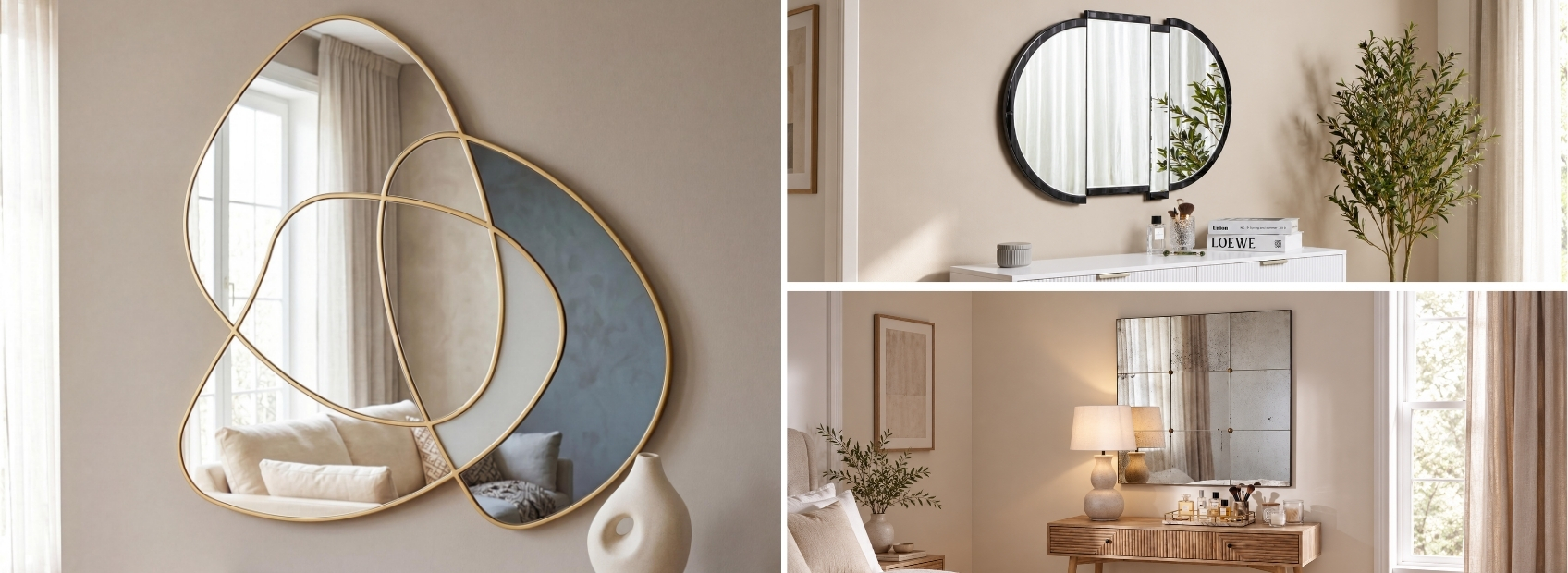
- Hanging a mirror directly opposite another mirror, which creates a repeating tunnel reflection that reads as chaotic rather than spacious
- Choosing a heavy, dark or ornate frame in a room that's already visually busy, which reintroduces the clutter the mirror is meant to counter
- Hanging a mirror against a wall the same colour as its frame, which reduces contrast and blunts the sense of depth
- Skipping proper wall anchors or stud fixings on a large or full-length mirror, which is a safety risk as well as a styling one
What to check before buying a mirror for a small space
Once you know where the mirror will hang, work through these checks before committing to a specific piece.
- The wall or furniture width the mirror needs to match, aiming for at least two-thirds the width of what sits beneath it
- What the mirror will actually reflect at eye level from the doorway and main seating position, not just from directly in front of it
- The gap above furniture (10–20cm) or above the floor for a full-length piece (15–25cm)
- The wall fixing required for the mirror's weight, including stud or anchor points for anything over a kilogram or two
- Whether the frame thickness suits the room, or a frameless or slim-framed option would keep more wall visible
- The glass tint, since a heavily tinted or antiqued finish softens the light-reflecting effect compared with clear glass
Frequently asked questions
Where is the best place to position a mirror in a small room?
In most small rooms, the best position is the wall directly opposite the doorway or main entry point, since that's the first thing you see on entering and where a reflection registers most immediately. If that wall doesn't work with your layout, the next best option is the wall facing your main window, which puts the mirror to work reflecting daylight instead.
Should a mirror ever face a doorway?
Facing a mirror opposite a doorway is common practice, since it reflects the view into the next room or hallway and reads as continuous space rather than a stopping point. Check what's actually reflected from the doorway threshold, such as a cluttered cupboard or plain wall, before committing to the position.
Can you put two mirrors on opposite walls?
Two mirrors on opposite walls can work, but only if they're not perfectly aligned at the same height and width, since that combination creates a repeating tunnel reflection that reads as chaotic rather than spacious. Offsetting the pair slightly, or using two different sizes, lets each one still catch its own source of light without setting up a literal hall-of-mirrors effect.
How big should a mirror be to expand a space?
As a working rule, a mirror should cover at least two-thirds of the wall or piece of furniture it's paired with; going smaller reads as an afterthought rather than a considered feature. For a genuinely dramatic effect, an oversized mirror that runs close to the full height of the wall, floor to just below the ceiling, does more for a small room than any accessory-sized piece.
Do framed or frameless mirrors make a room look bigger?
The reflection itself works either way identically; the difference is how much of the wall the frame takes up. A frameless or very slim-framed mirror keeps more of the glass visible relative to the wall, which suits a small room where you want the wall to feel like it disappears, while a substantial frame reintroduces visual weight even though it can still look proportionate in a larger space.
Is it better to buy one large mirror or a cluster of smaller ones?
A deliberate cluster of smaller mirrors, hung as a fixed gallery arrangement on a single wall, can work well in a hallway or above a console. Scattering a few unrelated mirrors across different walls in the same room tends to read as clutter, so treat any multi-mirror arrangement as one composition.