Free Delivery
 365-Day Returns
 10 Million Happy Customers
 500,000 Products in Stock
2700 K
Classic light bulb
Warm, relaxing
Living rooms, bedrooms
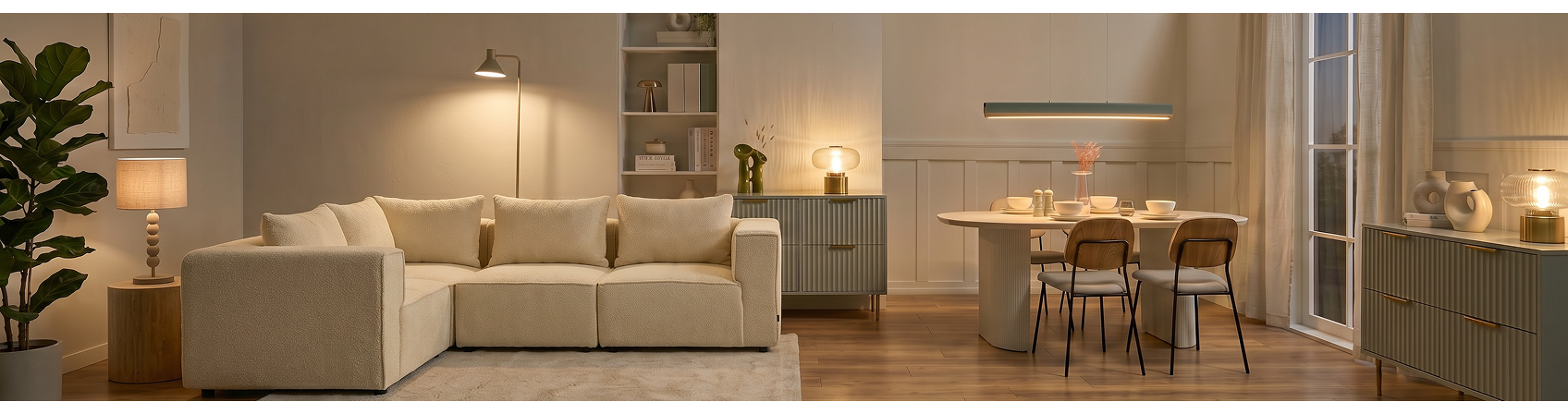
Lighting is one of those things you only notice when it's wrong. A room that feels cold and flat, a desk where your eyes ache by midday, a bedroom that never quite lets you wind down – more often than not, the culprit is the light. The good news? Choosing the right lamp isn't complicated. You need to know what to look for. This guide walks you through everything, room by room, so you can make a decision that feels right – and looks right – for years to come.
Before you start shopping, it helps to understand one simple idea: good lighting in any room is built in layers. Most people rely on a single ceiling light and wonder why the space never feels quite right. The answer is almost always that they're missing one or two layers.
The three layers are ambient, accent, and task lighting – and once you know them, you'll see them everywhere.
Your foundation. It fills the room with general, even light and sets the overall mood. Think ceiling lights, pendant lamps, or a floor lamp positioned to bounce light off the walls. A room with only ambient lighting tends to feel either too clinical (if the bulb is too bright and cool) or too dim (if the shade is too opaque). The goal is soft, comfortable visibility – enough to move around and feel at ease.
Personality. It draws the eye to something specific: a piece of art, a textured wall, a bookshelf, an architectural feature. Wall lamps, spotlights, and LED strips all serve this purpose. You don't need much of it – even a single well-placed wall sconce can completely change the character of a room.
Practical. It delivers focused, bright light exactly where you need it: above a reading chair, over a kitchen worktop, on a desk. This is the layer most people under-invest in, and it's the one that makes the biggest difference to how you feel at the end of a working day.
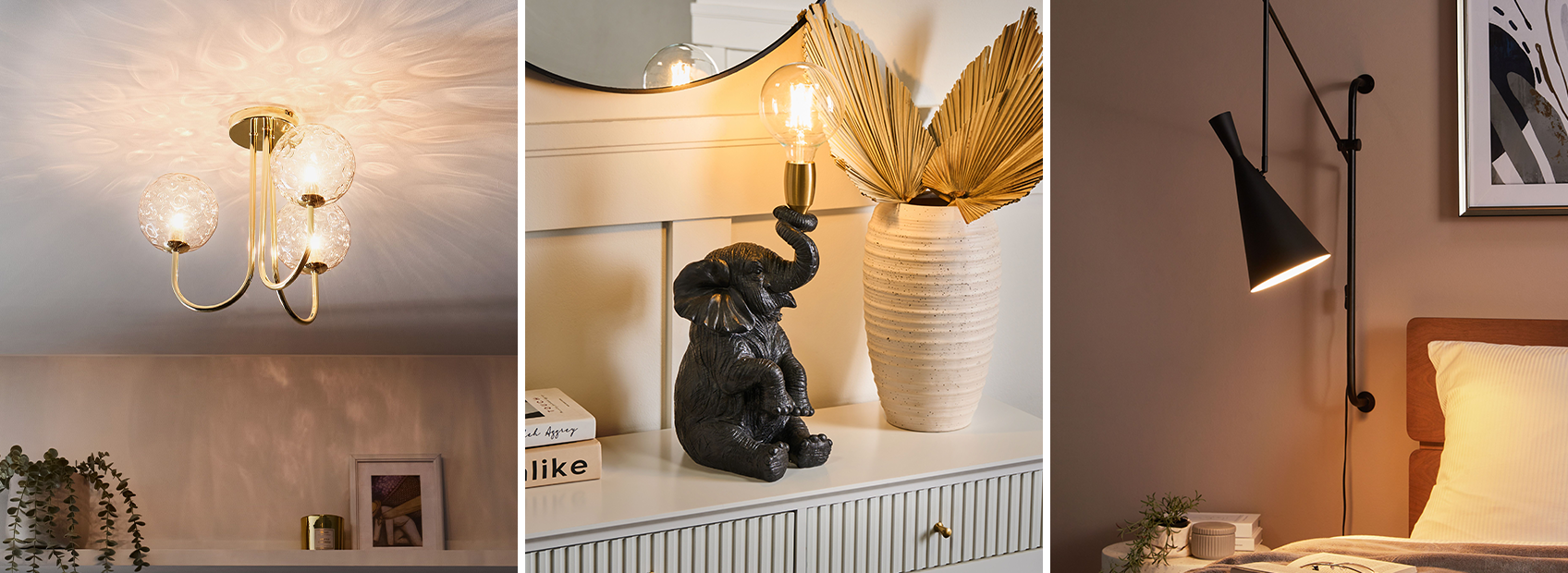
The living room needs to do everything – social space, relaxation zone, reading corner – so layers are non-negotiable. Start with a pendant or ceiling light as your base, then add a floor lamp beside the sofa and a table lamp on a side table for warmth and depth. Aim for bulbs in the 2700–3000K range; anything cooler will start to feel like an office.
What to look for
At least two lamp types, warm bulbs (2700–3000K), a floor lamp 150–180cm tall, dimmer-compatible fittings.
Avoid the single overhead light trap – ceiling lights in bedrooms are too bright and too impersonal for winding down. A pair of bedside lamps with warm bulbs (2700K or softer) is the foundation – add a floor lamp in a corner if you have the space. Look for a dimmer function – it's the simplest way to shift the room from daytime to evening mode.
What to look for
Warm bulbs (2700K or below), dimmer function, bedside lamps at shoulder height when seated in bed.
Dining room lighting has one job: make people look good and food look appetising. A pendant or chandelier hung 70–80cm above the table surface does both – it pools warm light exactly where you need it and gives the room a sense of occasion. Add a dimmer switch if you can; it's the cheapest upgrade that makes the biggest difference to atmosphere.
What to look for
Pendant or chandelier, warm bulbs (2700–3000K), hung 70–80cm above the table, dimmer switch.
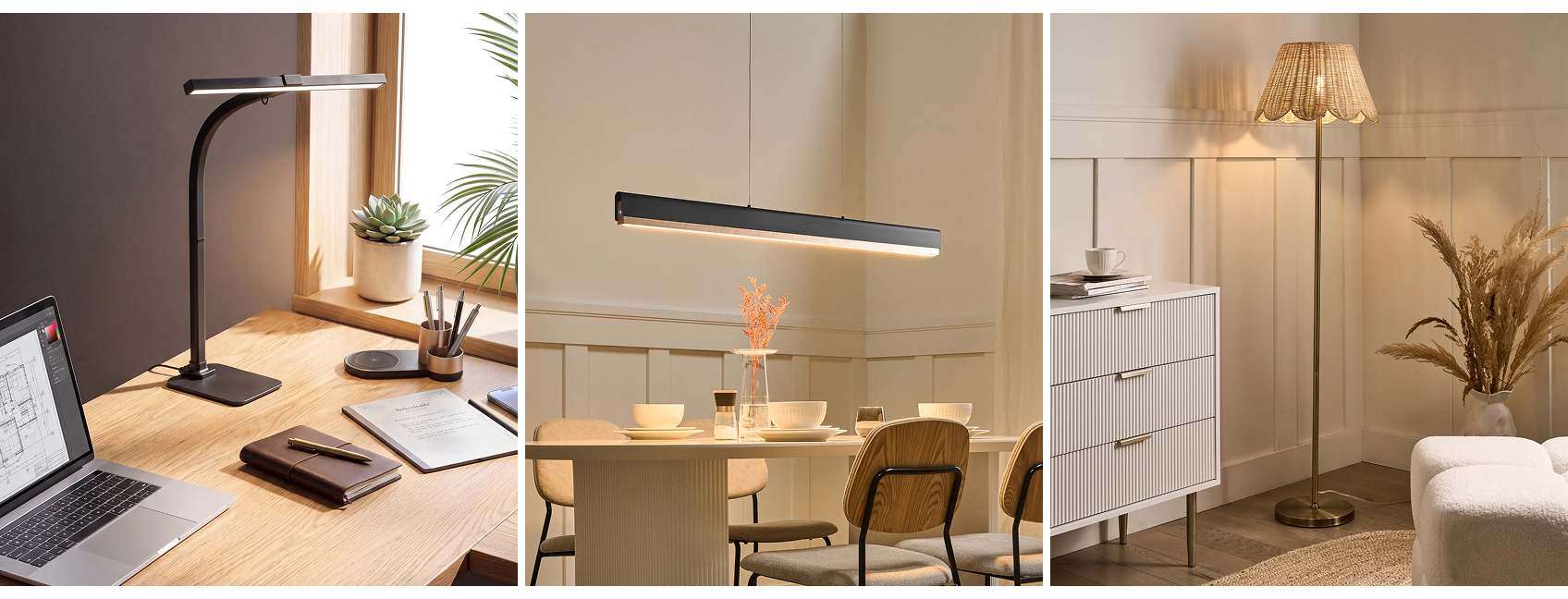
The goal for office lighting is bright, consistent, and glare-free – enough to keep you focused without exhausting you by mid-afternoon. A dedicated desk lamp with an adjustable arm and multiple colour temperature settings is the core piece: use a cooler setting (around 4000K) for focused work and a warmer one for video calls. Don't neglect the background – eye strain often comes from the contrast between a bright screen and a dark room, so add an ambient light source behind or beside your monitor.
What to look for
Adjustable arm, dimmer, multiple colour temperature modes, wide shade for even desk coverage.
Most people buy lamps without ever looking at the bulb specification – and then wonder why the light feels wrong. Here's a quick, plain-English breakdown of the numbers that actually matter.
How bright the bulb is. More lumens = more light. As a rough guide:
Wattage used to tell you this, but with LED bulbs it no longer does – a 10 W LED can produce as much light as a 60 W incandescent.
The "warmth" or "coolness" of the light. Lower numbers are warmer and more orange-toned; higher numbers are cooler and bluer. A quick guide:
Warm, relaxing
Living rooms, bedrooms
Good colour rendering
Kitchens, dining rooms
Comfortable and practical
Offices, schools, bathrooms
Energising, very bright
Workshops, hospitals
Enhanced focus, high colour accuracy
Industrial environments, drawing rooms
The socket type. E27 is the most common large screw fitting, E14 is the smaller screw, G9 and GU10 are pin fittings used in spotlights and some pendant lamps. Always check the fitting before buying a replacement bulb – they are not interchangeable.
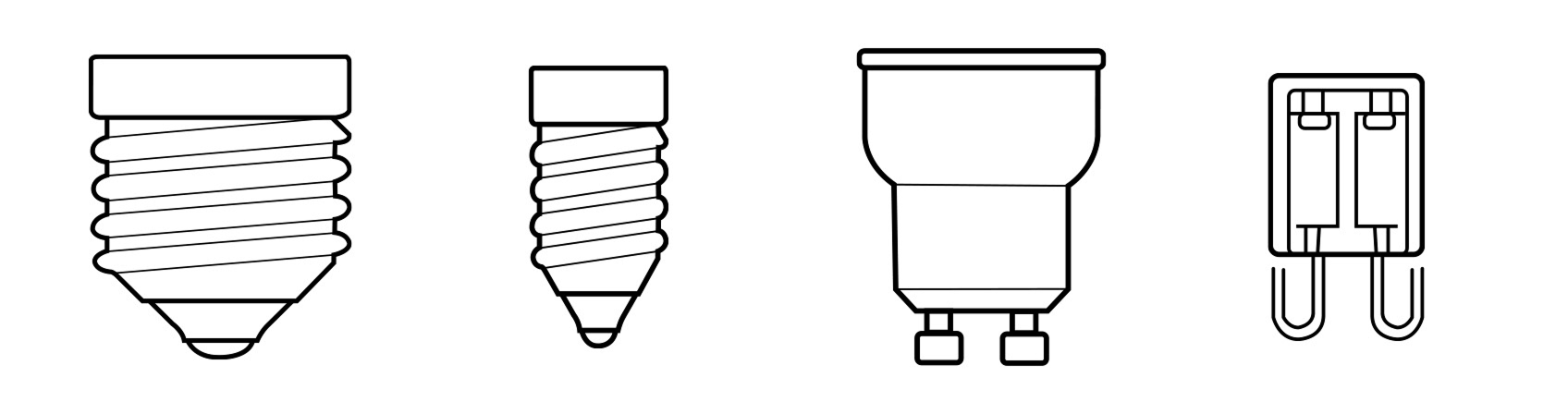
E27
Large Edison screw. Standard fitting for most table, floor and pendant lamps.
E14
Small Edison screw. Used on slimmer fittings such as chandeliers and smaller table lamps.
GU10
Twist-and-lock pin fitting. Common in spotlights and downlights.
G9
Small push-fit pin fitting. Found on compact fixtures and some pendant lamps.
LED lighting has moved well beyond its early reputation as flat and clinical. Modern LED bulbs are available across the full warmth spectrum, they dim smoothly, and they last – typically 15,000 to 25,000 hours compared to around 1,000 hours for a traditional incandescent. For context, that's roughly 20 years of average home use:
The practical benefits are straightforward:
For home offices in particular, LED bulbs with a high CRI (Colour Rendering Index of 90+) are worth seeking out. A high CRI means colours appear more accurate and natural under the light, which reduces the subtle visual fatigue that builds up over long work sessions.
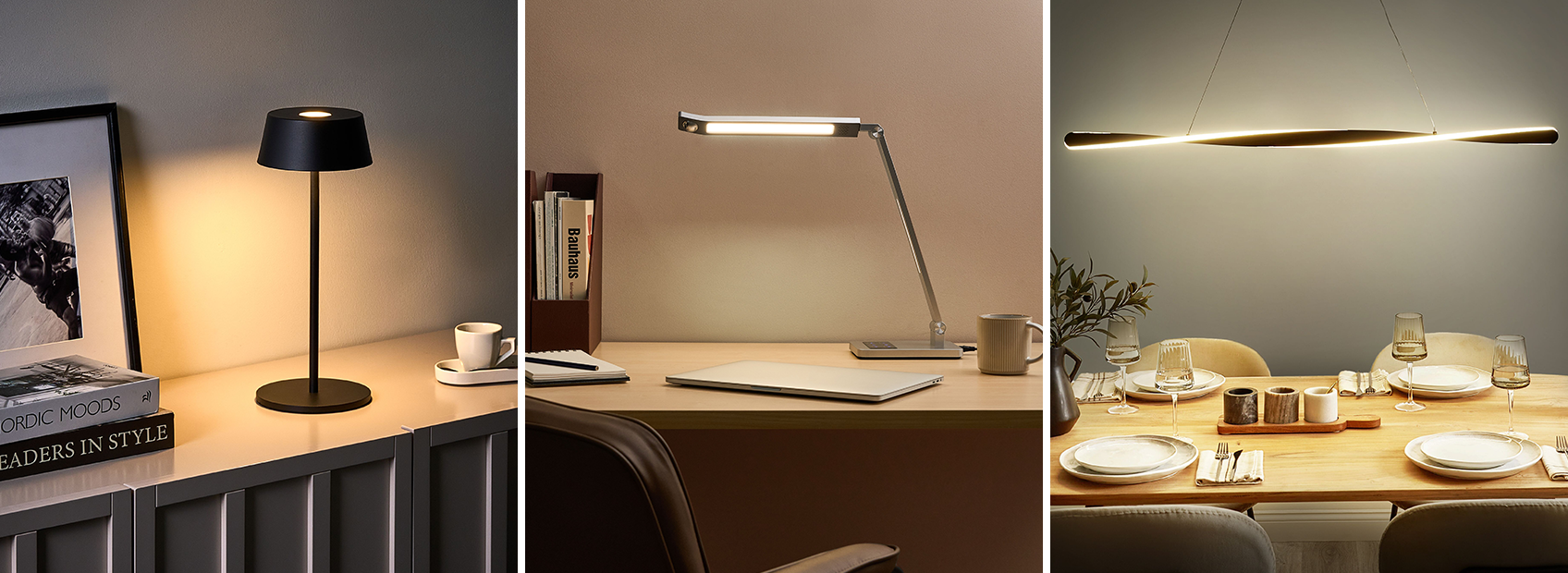
IP (Ingress Protection) ratings measure how well a lamp is sealed against dust and water. For most indoor rooms, you won't need to think about this at all – a standard lamp without an IP rating is perfectly fine for a living room, bedroom, or office. But there are three situations where it matters:
Not sure which lamp fits which room? Use this as your quick reference — match your room to the right lamp type and colour temperature before you shop.
| Room | Primary need | Recommended lamp type | Colour temperature |
|---|---|---|---|
Living room |
Primary needAtmosphere + flexibility | Recommended lamp typeFloor lamp + table lamp + pendant | 2700–3000K |
Bedroom |
Primary needRelaxation + reading | Recommended lamp typeBedside lamp + optional floor lamp | 2700K |
Dining room |
Primary needFocal point + warmth | Recommended lamp typePendant or chandelier above table | 2700–3000K |
Home office |
Primary needFocus + eye comfort | Recommended lamp typeAdjustable desk lamp + ambient background | 3000–4000K |
Bathroom |
Primary needClarity + safety | Recommended lamp typeWall lamp or ceiling light (IP44+) | 3000–4000K |
Hallway |
Primary needWelcoming + practical | Recommended lamp typeWall lamp or pendant | 3000K |
Kids' room |
Primary needSafe + fun | Recommended lamp typeCeiling light + bedside lamp | 2700–3000K |
Good lighting is cumulative – it's rarely one big decision but a series of small ones that add up to a room that genuinely feels good to be in. Here's what to remember as you shop:
Most rooms work best with two to three light sources covering different layers, such as one ambient source plus one task or accent lamp. A single overhead light rarely gives a room enough depth, while more than three sources in an average room is usually unnecessary.
It is best to keep all bulbs in a room within the same 500K band so the light looks consistent. Mixing a 2700K lamp with a 4000K lamp in the same space usually looks mismatched rather than intentional.
No, many lamps are sold as the fixture only, without a bulb. Always check the product listing for the fitting type and whether a bulb is included before you buy.
No, the right lumen output depends on the lamp's job, not on maximum brightness. A bedside lamp at 1500 lumens would feel harsh, while a ceiling light at 400 lumens would leave a medium room underlit.
Yes, a lamp with an IP44 or IP65 rating works perfectly well indoors, since a higher IP rating only adds protection rather than removing suitability for dry spaces. The reverse is not true: an indoor-only lamp should never be used outdoors or in a bathroom's wet zones.
A typical LED bulb lasts 15,000 to 25,000 hours, which works out to roughly 15 to 20 years of average home use. This is far longer than the approximately 1,000 hours you get from a traditional incandescent bulb.
May light be with you!
If an account with this email exists, you’ll receive an email with instructions to reset your password.
Log in