
 Free Delivery
 365-Day Returns
 10 Million Happy Customers
 500,000 Products in Stock
Lighting (1.314)


Lighting and Lamps
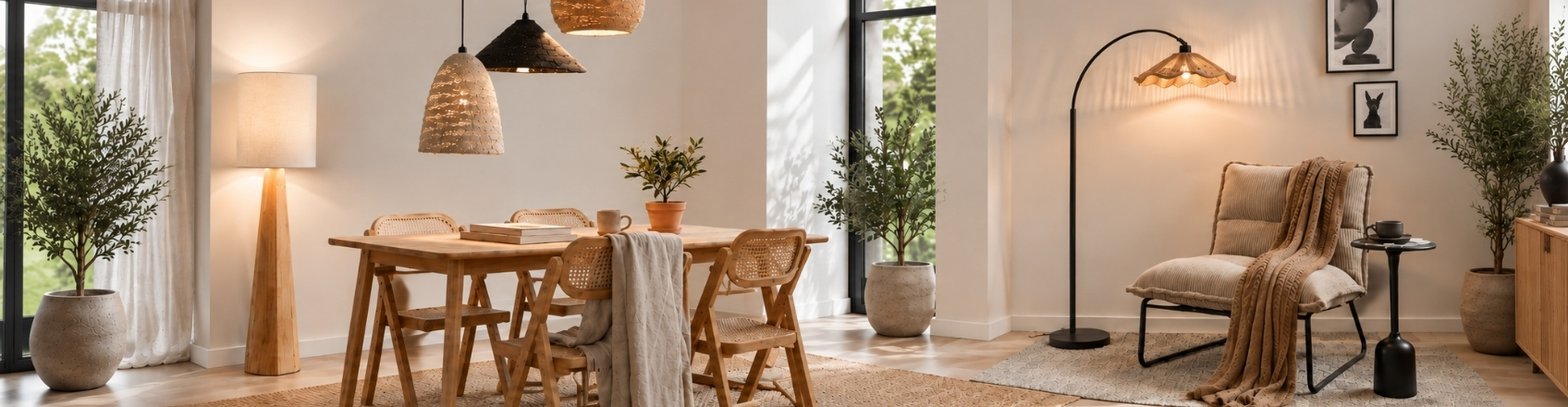
Lighting shapes both the mood and the function of a room, and getting it right usually means combining more than one type of fixture rather than relying on a single overhead light. This guide breaks down the main lighting types, explains what IP ratings mean for different areas of the home, and walks through the fixture types worth considering room by room.
What are the main types of lighting for a home?
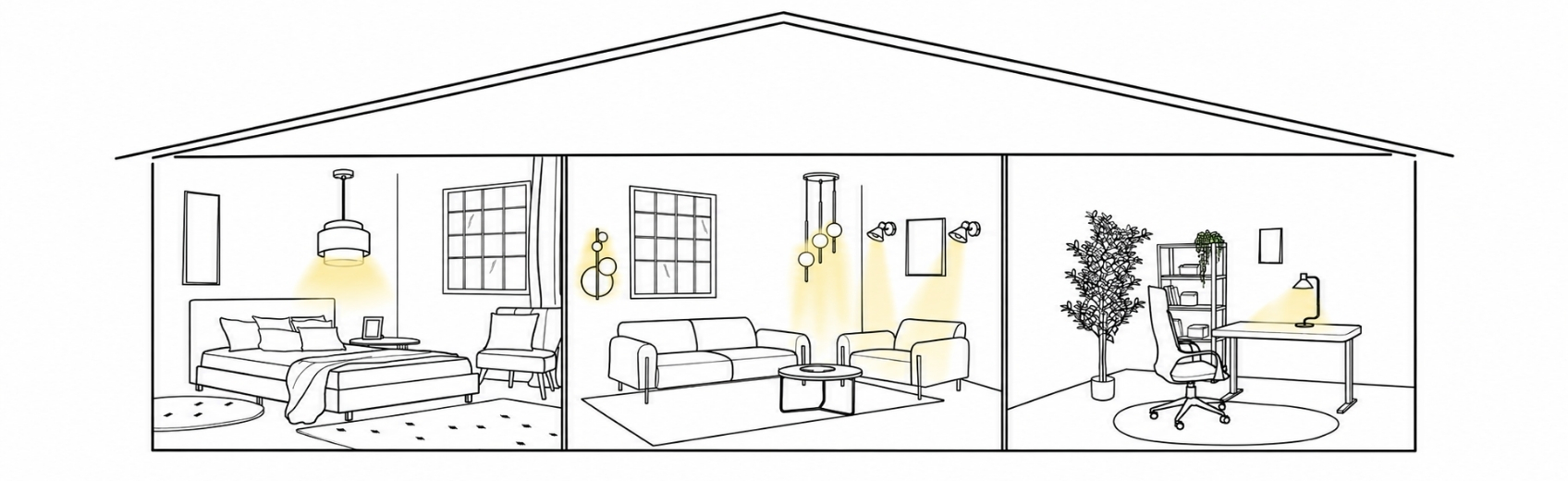
Most rooms need a layered mix of three lighting types rather than one fixture doing everything. Ambient lighting (ceiling fixtures, pendants, chandeliers) provides the even base light for the whole room. Task lighting (desk lamps, under-cabinet lights) gives focused brightness for one activity like reading or cooking. Accent lighting (spotlights, wall sconces, LED strips) draws attention to a specific feature such as artwork or a textured wall.
Ambient
The base light in a room
Even, soft light that fills the whole space, usually from ceiling fixtures, pendants or chandeliers.
Accent
Highlights a feature
Draws attention to artwork or a textured wall using spotlights, wall sconces or LED strips.
Task
Focused for one activity
Targeted brightness for reading, cooking or working, from desk lamps or under-cabinet lights.
Shop now: office lighting and LED lights
Why are LED lamps the best choice now?
LED lamps use up to 75% less energy than incandescent bulbs, which lowers running costs over time. They also last far longer than traditional bulbs, cutting down how often lamps need replacing, and they contain no mercury, unlike some traditional bulbs. LED lamps also reach full brightness instantly, with no warm-up delay, which makes them well suited to both task lighting and general ambience.
| Factor | LED lamps | Traditional bulbs |
|---|---|---|
| Energy use | Up to 75% less energy for the same brightness | Higher energy use for equivalent light output |
| Lifespan | Rated for tens of thousands of hours | Much shorter lifespan, more frequent replacement |
| Warm-up time | Instant full brightness | Some types need time to reach full brightness |
| Materials | No mercury content | Some traditional bulb types contain mercury |
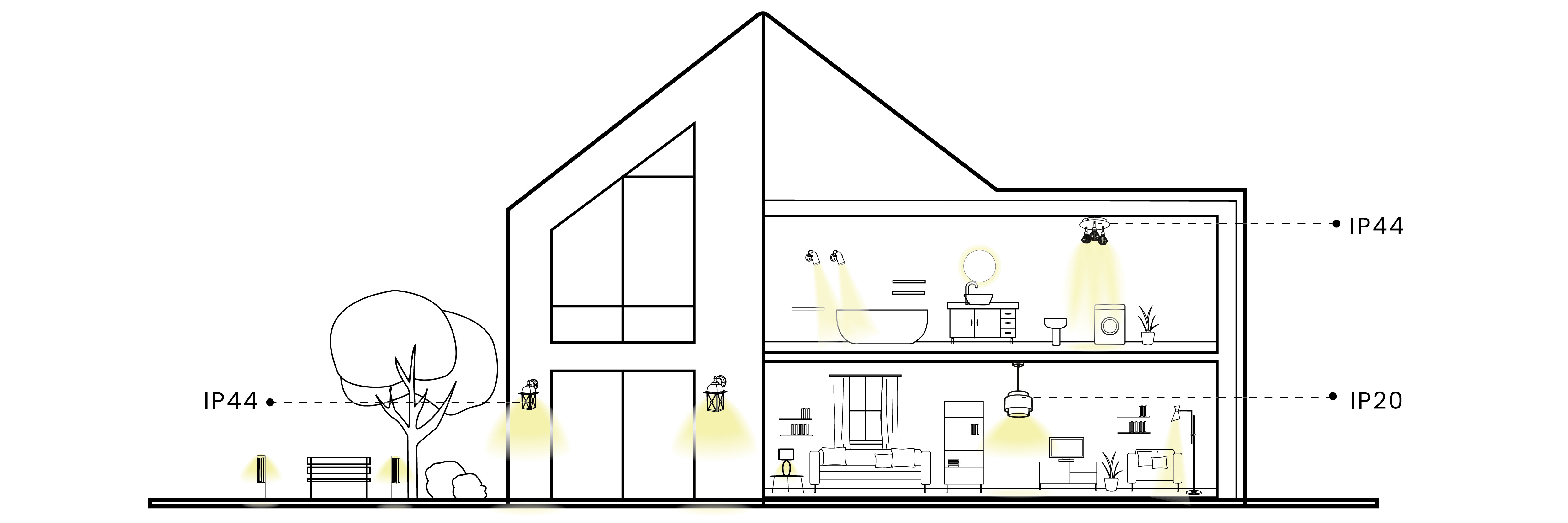
What IP rating do you need for different areas of the home?
How do you read an IP rating?
IP stands for Ingress Protection. The first digit shows protection against solid objects and dust, while the second digit shows protection against water. For example, IP44 means protection against solid objects larger than 1 mm and splashing water, while IP65 means dust-tight protection and resistance to water jets.
| Rooms | Typical IP rating | What it means in practice |
|---|---|---|
| Living rooms, bedrooms, dining rooms and hallways | IP20 | Suitable for dry indoor rooms where the lamp will not be exposed to steam, splashes or outdoor moisture. |
| Kitchens and utility rooms | IP20 to IP44 | IP20 is usually enough away from water. Choose IP44 near sinks, worktops or areas where splashes are likely. |
| Bathrooms and splash-prone areas | IP44 or higher | Use for bathroom areas exposed to humidity or occasional splashes. Lamps placed close to showers, baths or sinks need stronger water protection than dry-room fixtures. |
| Covered balconies, porches and sheltered patios | IP44 to IP54 | Good for outdoor lamps protected by a roof or overhang, where rain is indirect but damp air, wind-blown moisture or dust may still reach the fitting. |
| Gardens, terraces, driveways and exposed walls | IP65 | Better for fully exposed outdoor lighting because it is dust-tight and protected against water jets, including heavy rain and regular weather exposure. |
| Ground-level path lights and areas near pooling water | IP67 | Use where the fitting may face temporary immersion, puddles or stronger water exposure. This is more relevant for low outdoor lights than for standard wall or ceiling lamps. |
Shop now: outdoor lighting
Which lamp functions are worth considering?
Extra lamp functions are useful when they solve a real daily problem, not when they only add complexity. Before choosing a lamp, think about whether you need flexible brightness, automatic switching, easier control or better energy management.
Dimmable light
For changing the mood
A dimmer lets one lamp move between bright task lighting and softer evening light. It is especially useful in living rooms, bedrooms and dining areas where the same fixture serves more than one purpose.
Motion sensor
For practical automatic light
A motion sensor switches the light on when movement is detected, which works well for hallways, entrances, driveways and garden paths. It improves convenience and helps avoid leaving outdoor lights on unnecessarily.
Timer
For scheduled lighting
A timer is useful when you want lamps to switch on or off at set times, for example in outdoor areas, children's rooms or decorative lighting. It is best for predictable routines rather than spaces used at changing times.
Adjustable design
For directing the beam
Adjustable arms, heads or heights help direct light exactly where it is needed. This matters most for desk lamps, reading lamps, floor lamps and spotlights used for task or accent lighting.
Remote or touch control
For easier everyday use
Remote and touch controls make lamps easier to operate from a bed, sofa or desk. They are most useful for ceiling lights, bedside lamps and fixtures placed where the main switch is not convenient.
Colour temperature
For warmer or clearer light
Some LED lamps let you switch between warmer and cooler light. Warm light suits bedrooms and living rooms, while cooler light is better for desks, kitchens and practical work areas.
Kids lighting
Kids lighting combines playful designs with safe, functional light for bedrooms and play areas, from colourful ceiling lights to themed table lamps. Soft, warm light supports a calming bedtime routine, while durable materials and child-friendly operation keep safety a priority.
Shop now: kids lighting
What do lumens and kelvins mean?
Lumens tell you how bright a lamp is. More lumens mean stronger light, so they are better for kitchens, hallways, desks and other places where you need clear visibility. Fewer lumens give softer light, which works better for bedrooms, living rooms, bedside lamps and decorative lighting.
Kelvins tell you the colour temperature of the light. A lower kelvin value looks warmer and more yellow, while a higher kelvin value looks cooler, clearer and slightly blue-toned. This affects the mood of the room as much as the visibility, so warmer light is usually better for relaxing rooms and cooler light is better for work areas.
| Kelvin range | Light colour | Best rooms |
|---|---|---|
| 2700K-3000K | Warm white, soft and slightly yellow | Bedrooms, living rooms, dining rooms and cosy seating areas |
| 3500K-4000K | Neutral white, clear and balanced | Kitchens, bathrooms, wardrobes and hallways |
| Above 4000K | Cool white, sharper and slightly blue-toned | Home offices, garages, utility rooms and task areas |
Read more: ultimate guide to choosing the right lamp
What to check before buying a lamp
Once you know which room and task the lamp is for, work through these checks before adding it to your basket.
- Match the lamp type to the lighting role it needs to play: ambient, accent or task
- Check the IP rating against the location, especially for bathrooms and outdoor spaces
- Confirm the bulb fitting and wattage equivalence match what the fixture needs
- Look for dimmable settings if the room needs to shift between bright and relaxed lighting
- Check the lamp's adjustability (height, arm, head) if it needs to serve more than one task
- For kids' rooms, confirm the materials and operation are child-safe
Frequently asked questions
Do LED lamps fit standard light fittings?
Most LED lamps and bulbs are made to fit standard fittings such as E27 or E14, so they can replace incandescent or halogen bulbs directly. Always check the fitting size and wattage equivalence listed on the product before buying.
Is a higher IP rating always better?
A higher IP rating means better protection against dust and water, but it is not automatically better for every location. An IP44 lamp is unnecessary in a dry living room, while it becomes essential in a bathroom splash zone or outdoors.
How often do LED lamps need replacing?
LED lamps typically last far longer than incandescent bulbs, often rated for tens of thousands of hours of use. In everyday household use, this can mean many years between replacements rather than the frequent changes traditional bulbs need.